
Lorem ipsum dolor sit amet, consectetur adipiscing elit. Etiam enim nulla, egestas eu hendrerit vel, congue interdum dui. Integer sed leo posuere, consectetur sem id, placerat diam. Suspendisse potenti. Mauris tincidunt libero risus, id aliquam leo eleifend ut. Donec quis luctus urna, quis vulputate nunc. In vel augue lectus. Maecenas faucibus velit libero, ut auctor lacus gravida nec. Sed tempor urna metus, sit amet interdum libero interdum eu. Interdum et malesuada fames ac ante ipsum primis in faucibus. Nullam quis velit sagittis, eleifend dolor sed, luctus enim. Sed mi nisl, cursus eu gravida sit amet, maximus euismod nulla. Duis quam libero, tristique id venenatis eu, vulputate at arcu. Integer pellentesque elementum felis, mattis tristique lacus ullamcorper at.
Search Results
No results found
About 227
- Title: 227
- Author(s): Baron Ferdinand De RothChild
- Date of creation: 1890
- Extent: 2pp
- Material: Paper
- Physical Location: Waddesdon Manor
Annotations
Transcript
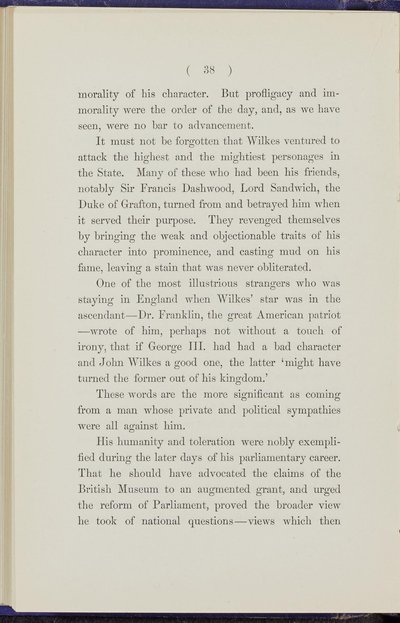
( 38 )
morality of his character. But profligacy and im-
morality were the order of the day, and, as we have
seen, were no bar to advancement.
It must not be forgotten that Wilkes ventured to
attack the highest and the mightiest personages in
the State. Many of these who had been his friends,
notably Sir Francis Dashwood, Lord Sandwich, the
Duke of Grafton, turned from and betrayed him when
it served their purpose. They revenged themselves
by bringing the weak and objectionable traits of his
character into prominence, and casting mud on his
fame, leaving a stain that was never obliterated.
One of the most illustrious strangers who was
staying in England when Wilkes’ star was in the
ascendant—Dr. Franklin, the great American patriot
—wrote of him, perhaps not without a touch of
irony, that if George III. had had a bad character
and John Wilkes a good one, the latter ‘might have
turned the former out of his kingdom.’
These words are the more significant as coming
from a man whose private and political sympathies
were all against him.
His humanity and toleration were nobly exempli-
fied during the later days of his parliamentary career.
That he should have advocated the claims of the
British Museum to an augmented grant, and urged
the reform of Parliament, proved the broader view
he took of national questions—views which then