
Lorem ipsum dolor sit amet, consectetur adipiscing elit. Etiam enim nulla, egestas eu hendrerit vel, congue interdum dui. Integer sed leo posuere, consectetur sem id, placerat diam. Suspendisse potenti. Mauris tincidunt libero risus, id aliquam leo eleifend ut. Donec quis luctus urna, quis vulputate nunc. In vel augue lectus. Maecenas faucibus velit libero, ut auctor lacus gravida nec. Sed tempor urna metus, sit amet interdum libero interdum eu. Interdum et malesuada fames ac ante ipsum primis in faucibus. Nullam quis velit sagittis, eleifend dolor sed, luctus enim. Sed mi nisl, cursus eu gravida sit amet, maximus euismod nulla. Duis quam libero, tristique id venenatis eu, vulputate at arcu. Integer pellentesque elementum felis, mattis tristique lacus ullamcorper at.
Search Results
No results found
About 227
- Title: 227
- Author(s): Baron Ferdinand De RothChild
- Date of creation: 1890
- Extent: 2pp
- Material: Paper
- Physical Location: Waddesdon Manor
Annotations
Transcript
es)
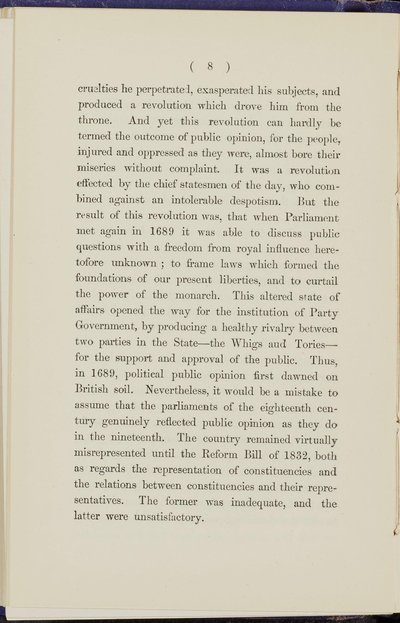
eruelties he perpetrate], exasperated his subjects, and
produced a revolution which drove him from the
throne. And yet this revolution can hardly be
termed the outcome of public opinion, for the people,
injured and oppressed as they were, almost bore their
miseries without complaint. It was a revolution
effected by the chief statesmen of the day, who com- J
bined against an intolerable despotism. But the
result of this revolution was, that when Parliament
met again in 1689 it was able to discuss public
questions with a freedom from royal influence here-
tofore unknown ; to frame laws which formed the
foundations of our present liberties, and to curtail
the power of the monarch. This altered state of
affairs opened the way for the institution of Party
Government, by producing a healthy rivalry between
two parties in the State—the Whigs aud Tories—
for the support and approval of the public. Thus,
in 1689, political public opinion first dawned on
British soil. Nevertheless, it would be a mistake to
assume that the parliaments of the eighteenth cen- |
tury genuinely reflected publie opimion as they do
in the nineteenth. The country remained virtually
misrepresented until the Reform Bill of 1832, both |
as regards the representation of constituencies and
the relations between constituencies and their repre-
sentatives. The former was inadequate, and the
latter were unsatisfactory.