
Lorem ipsum dolor sit amet, consectetur adipiscing elit. Etiam enim nulla, egestas eu hendrerit vel, congue interdum dui. Integer sed leo posuere, consectetur sem id, placerat diam. Suspendisse potenti. Mauris tincidunt libero risus, id aliquam leo eleifend ut. Donec quis luctus urna, quis vulputate nunc. In vel augue lectus. Maecenas faucibus velit libero, ut auctor lacus gravida nec. Sed tempor urna metus, sit amet interdum libero interdum eu. Interdum et malesuada fames ac ante ipsum primis in faucibus. Nullam quis velit sagittis, eleifend dolor sed, luctus enim. Sed mi nisl, cursus eu gravida sit amet, maximus euismod nulla. Duis quam libero, tristique id venenatis eu, vulputate at arcu. Integer pellentesque elementum felis, mattis tristique lacus ullamcorper at.
Search Results
No results found
About 227
- Title: 227
- Author(s): Baron Ferdinand De RothChild
- Date of creation: 1890
- Extent: 2pp
- Material: Paper
- Physical Location: Waddesdon Manor
Annotations
Transcript
ole)
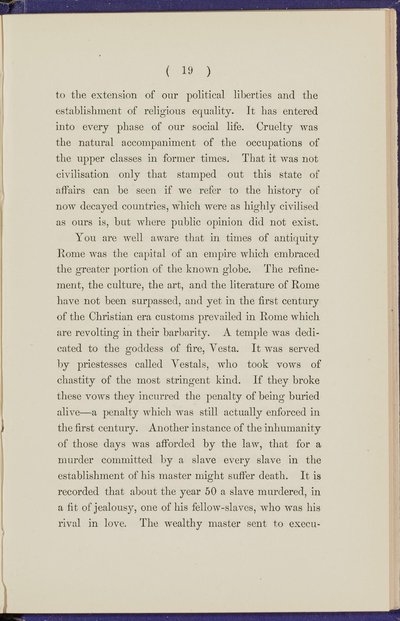
to the extension of our political liberties and the
establishment of religious equality. It has entered
into every phase of our social life. Cruelty was
the natural accompaniment of the occupations of
the upper classes in former times. That it was not
civilisation only that stamped out this state of
affairs can be seen if we refer to the history of
now decayed countries, which were as highly civilised
as ours is, but where public opinion did not exist.
You are well aware that in times of antiquity
Rome was the capital of an empire which embraced
the greater portion of the known globe. The refine-
ment, the culture, the art, and the literature of Rome
have not been surpassed, and yet in the first century
of the Christian era customs prevailed in Rome which
are revolting in their barbarity. A temple was dedi-
cated to the goddess of fire, Vesta. It was served
by priestesses called Vestals, who took vows of
chastity of the most stringent kind. If they broke
these vows they incurred the penalty of being buried
alive
a penalty which was still actually enforced in
the first century. Another instance of the inhumanity
of those days was afforded by the law, that for a
murder committed by a slave every slave in the
establishment of his master might suffer death. It is
recorded that about the year 50 a slave murdered, in
a fit of jealousy, one of his fellow-slaves, who was his
rival in love. The wealthy master sent to execu-