
Lorem ipsum dolor sit amet, consectetur adipiscing elit. Etiam enim nulla, egestas eu hendrerit vel, congue interdum dui. Integer sed leo posuere, consectetur sem id, placerat diam. Suspendisse potenti. Mauris tincidunt libero risus, id aliquam leo eleifend ut. Donec quis luctus urna, quis vulputate nunc. In vel augue lectus. Maecenas faucibus velit libero, ut auctor lacus gravida nec. Sed tempor urna metus, sit amet interdum libero interdum eu. Interdum et malesuada fames ac ante ipsum primis in faucibus. Nullam quis velit sagittis, eleifend dolor sed, luctus enim. Sed mi nisl, cursus eu gravida sit amet, maximus euismod nulla. Duis quam libero, tristique id venenatis eu, vulputate at arcu. Integer pellentesque elementum felis, mattis tristique lacus ullamcorper at.
Search Results
No results found
About 227
- Title: 227
- Author(s): Baron Ferdinand De RothChild
- Date of creation: 1890
- Extent: 2pp
- Material: Paper
- Physical Location: Waddesdon Manor
Annotations
Transcript
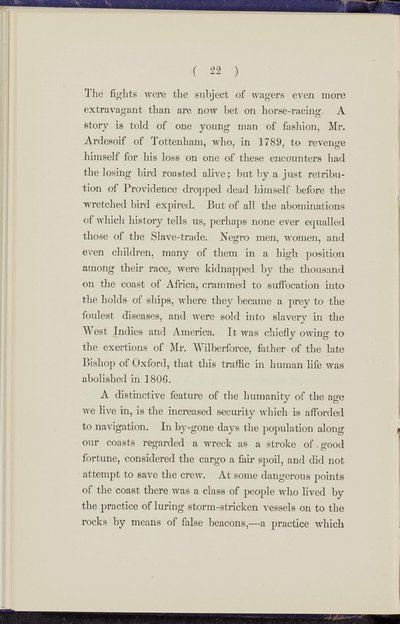
The fights were the subject of wagers even more
extravagant than are now bet on horse-racing. A
story is told of one young man of fashion, Mr.
Ardesoif of Tottenham, who, in 1789, to revenge
himself for his loss on one of these encounters had
the losing bird roasted alive; but by a just retribu-
tion of Providence dropped dead himself before the
wretched bird expired. But of all the abominations
of which history tells us, perhaps none ever equalled
those of the Slave-trade. Negro men, women, and
even children, many of them in a high position
among their race, were kidnapped by the thousand
on the coast of Africa, crammed to suffocation into
the holds of ships, where they became a prey to the
foulest diseases, and were sold into slavery in the
West Indies and America. It was chiefly owing to
the exertions of Mr. Wilberforce, father of the late
Bishop of Oxford, that this traffic in human life was
abolished in 1806.
A distinctive feature of the humanity of the age
we live in, is the increased security which is afforded
to navigation. In by-gone days the population along
our coasts regarded a wreck as a stroke of. good
fortune, considered the cargo a fair spoil, and did not
attempt to save the crew. At some dangerous points
of the coast there was a class of people who lived by
the practice of luring storm-stricken vessels on to the
rocks by means of false beacons,
a practice which