
Lorem ipsum dolor sit amet, consectetur adipiscing elit. Etiam enim nulla, egestas eu hendrerit vel, congue interdum dui. Integer sed leo posuere, consectetur sem id, placerat diam. Suspendisse potenti. Mauris tincidunt libero risus, id aliquam leo eleifend ut. Donec quis luctus urna, quis vulputate nunc. In vel augue lectus. Maecenas faucibus velit libero, ut auctor lacus gravida nec. Sed tempor urna metus, sit amet interdum libero interdum eu. Interdum et malesuada fames ac ante ipsum primis in faucibus. Nullam quis velit sagittis, eleifend dolor sed, luctus enim. Sed mi nisl, cursus eu gravida sit amet, maximus euismod nulla. Duis quam libero, tristique id venenatis eu, vulputate at arcu. Integer pellentesque elementum felis, mattis tristique lacus ullamcorper at.
Search Results
No results found
About 227
- Title: 227
- Author(s): Baron Ferdinand De RothChild
- Date of creation: 1890
- Extent: 2pp
- Material: Paper
- Physical Location: Waddesdon Manor
Annotations
Transcript
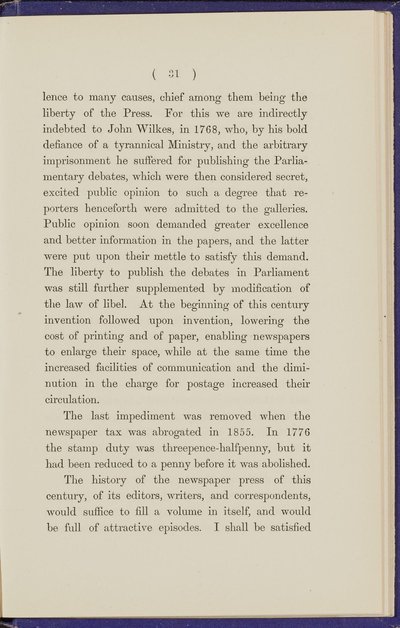
lence to many causes, chief among them being the
liberty of the Press. For this we are indirectly
indebted to John Wilkes, in 1768, who, by his bold
defiance of a tyrannical Ministry, and the arbitrary
imprisonment he suffered for publishing the Parlia-
mentary debates, which were then considered secret,
excited public opinion to such a degree that re-
porters henceforth were admitted to the galleries.
Public opinion soon demanded greater excellence
and better information in the papers, and the latter
were put upon their mettle to satisfy this demand.
The liberty to publish the debates in Parliament
was still further supplemented by modification of
the law of libel. At the beginning of this century
invention followed upon invention, lowering the
cost of printing and of paper, enabling newspapers
to enlarge their space, while at the same time the
increased facilities of communication and the dimi-
nution in the charge for postage increased their
circulation.
The last impediment was removed when the
newspaper tax was abrogated in 1855. In 1776
the stamp duty was threepence-halfpenny, but it
had been reduced to a penny before it was abolished.
The history of the newspaper press of this
century, of its editors, writers, and correspondents,
would suffice to fill a volume in itself, and would
be full of attractive episodes. I shall be satisfied