
Lorem ipsum dolor sit amet, consectetur adipiscing elit. Etiam enim nulla, egestas eu hendrerit vel, congue interdum dui. Integer sed leo posuere, consectetur sem id, placerat diam. Suspendisse potenti. Mauris tincidunt libero risus, id aliquam leo eleifend ut. Donec quis luctus urna, quis vulputate nunc. In vel augue lectus. Maecenas faucibus velit libero, ut auctor lacus gravida nec. Sed tempor urna metus, sit amet interdum libero interdum eu. Interdum et malesuada fames ac ante ipsum primis in faucibus. Nullam quis velit sagittis, eleifend dolor sed, luctus enim. Sed mi nisl, cursus eu gravida sit amet, maximus euismod nulla. Duis quam libero, tristique id venenatis eu, vulputate at arcu. Integer pellentesque elementum felis, mattis tristique lacus ullamcorper at.
Search Results
No results found
About 227
- Title: 227
- Author(s): Baron Ferdinand De RothChild
- Date of creation: 1890
- Extent: 2pp
- Material: Paper
- Physical Location: Waddesdon Manor
Annotations
Transcript
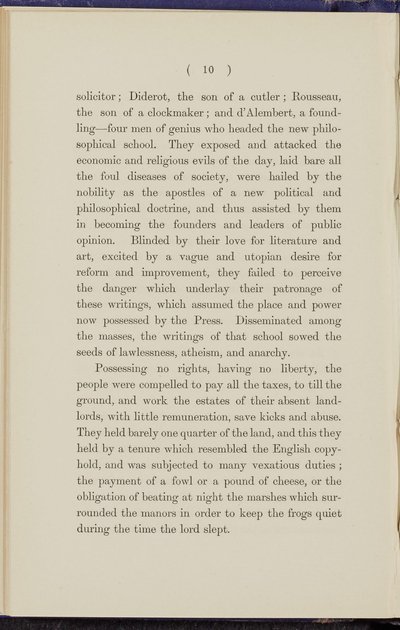
solicitor; Diderot, the son of a cutler ; Rousseau,
the son of a clockmaker; and d’Alembert, a found-
ling—four men of genius who headed the new philo-
sophical school. They exposed and attacked the
economic and religious evils of the day, laid bare all
the foul diseases of society, were hailed by the
nobility as the apostles of a new political and
philosophical doctrine, and thus assisted by them
in becoming the founders and leaders of public
opinion. Blinded by their love for literature and
art, excited by a vague and utopian desire for
reform and improvement, they failed to perceive
the danger which underlay their patronage of
these writings, which assumed the place and power
now possessed by the Press. Disseminated among
the masses, the writings of that school sowed the
seeds of lawlessness, atheism, and anarchy.
Possessing no rights, having no liberty, the
people were compelled to pay all the taxes, to till the
ground, and work the estates of their absent land-
lords, with little remuneration, save kicks and abuse.
They held barely one quarter of the land, and this they
held by a tenure which resembled the English copy-
hold, and was subjected to many vexatious duties ;
the payment of a fowl or a pound of cheese, or the
obligation of beating at night the marshes which sur-
rounded the manors in order to keep the frogs quiet
during the time the lord slept.
a