
Lorem ipsum dolor sit amet, consectetur adipiscing elit. Etiam enim nulla, egestas eu hendrerit vel, congue interdum dui. Integer sed leo posuere, consectetur sem id, placerat diam. Suspendisse potenti. Mauris tincidunt libero risus, id aliquam leo eleifend ut. Donec quis luctus urna, quis vulputate nunc. In vel augue lectus. Maecenas faucibus velit libero, ut auctor lacus gravida nec. Sed tempor urna metus, sit amet interdum libero interdum eu. Interdum et malesuada fames ac ante ipsum primis in faucibus. Nullam quis velit sagittis, eleifend dolor sed, luctus enim. Sed mi nisl, cursus eu gravida sit amet, maximus euismod nulla. Duis quam libero, tristique id venenatis eu, vulputate at arcu. Integer pellentesque elementum felis, mattis tristique lacus ullamcorper at.
Search Results
No results found
About 227
- Title: 227
- Author(s): Baron Ferdinand De RothChild
- Date of creation: 1890
- Extent: 2pp
- Material: Paper
- Physical Location: Waddesdon Manor
Annotations
Transcript
( 29 )
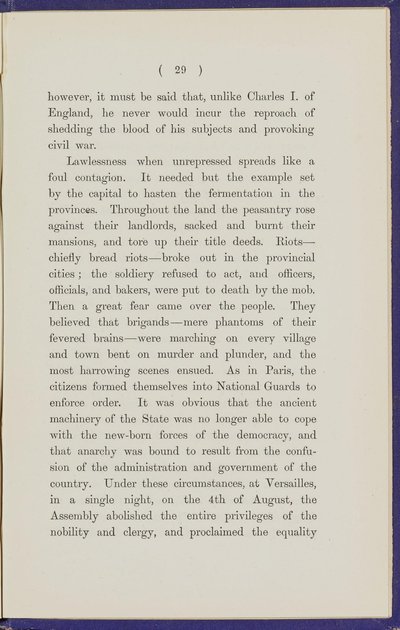
however, it must be said that, unlike Charles I. of
England, he never would incur the reproach of
shedding the blood of his subjects and provoking
civil war.
Lawlessness when unrepressed spreads like a
foul contagion. It needed but the example set
by the capital to hasten the fermentation in the
provinces. Throughout the land the peasantry rose
against their landlords, sacked and burnt their
mansions, and tore up their title deeds. Riots—
chiefly bread riots—broke out in the provincial
cities ; the soldiery refused to act, and _ officers,
officials, and bakers, were put to death by the mob.
Then a great fear came over the people. They
believed that brigands—mere phantoms of their
fevered brains—were marching on every village
and town bent on murder and plunder, and the
most harrowing scenes ensued. As in Paris, the .
citizens formed themselves into National Guards to
enforce order. It was obvious that the ancient
machinery of the State was no longer able to cope
with the new-born forces of the democracy, and
that anarchy was bound to result from the confu-
sion of the administration and government of the
country. Under these circumstances, at Versailles,
in a single night, on the 4th of August, the
Assembly abolished the entire privileges of the
nobility and clergy, and proclaimed the equality