
Lorem ipsum dolor sit amet, consectetur adipiscing elit. Etiam enim nulla, egestas eu hendrerit vel, congue interdum dui. Integer sed leo posuere, consectetur sem id, placerat diam. Suspendisse potenti. Mauris tincidunt libero risus, id aliquam leo eleifend ut. Donec quis luctus urna, quis vulputate nunc. In vel augue lectus. Maecenas faucibus velit libero, ut auctor lacus gravida nec. Sed tempor urna metus, sit amet interdum libero interdum eu. Interdum et malesuada fames ac ante ipsum primis in faucibus. Nullam quis velit sagittis, eleifend dolor sed, luctus enim. Sed mi nisl, cursus eu gravida sit amet, maximus euismod nulla. Duis quam libero, tristique id venenatis eu, vulputate at arcu. Integer pellentesque elementum felis, mattis tristique lacus ullamcorper at.
Search Results
No results found
About 227
- Title: 227
- Author(s): Baron Ferdinand De RothChild
- Date of creation: 1890
- Extent: 2pp
- Material: Paper
- Physical Location: Waddesdon Manor
Annotations
Transcript
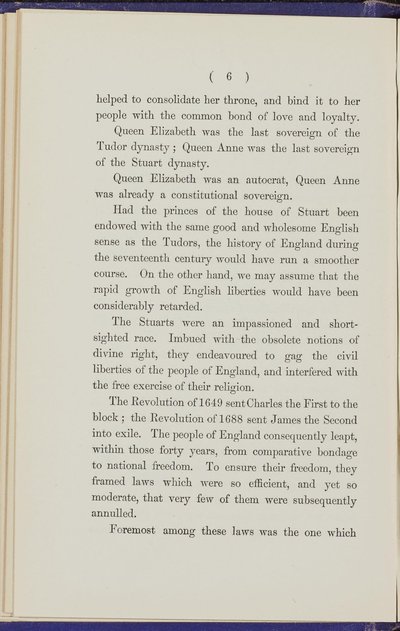
( 6 )
helped to consolidate her throne, and bind it to her
people with the common bond of love and loyalty.
Queen Elizabeth was the last sovereign of the
Tudor dynasty ; Queen Anne was the last sovereion
of the Stuart dynasty.
Queen Elizabeth was an autocrat, Queen Anne
was already a constitutional sovereign.
Had the princes of the house of Stuart been
endowed with the same good and wholesome English
sense as the Tudors, the history of England during
the seventeenth century would have run a smoother
course. On the other hand, we may assume that the
rapid growth of English liberties would have been
considerably retarded.
The Stuarts were an impassioned and _ short-
sighted race. Imbued with the obsolete notions of
divine right, they endeavoured to gag the civil
liberties of the people of England, and interfered with
the free exercise of their religion.
The Revolution of 1649 sent Charles the First to the
block ; the Revolution of 1688 sent James the Second
into exile. The people of England consequently leapt,
within those forty years, from comparative bondage
to national freedom. To ensure their freedom, they
framed laws which were so efficient, and yet so
moderate, that very few of them were subsequently
annulled.
Foremost among these laws was the one which