
Lorem ipsum dolor sit amet, consectetur adipiscing elit. Etiam enim nulla, egestas eu hendrerit vel, congue interdum dui. Integer sed leo posuere, consectetur sem id, placerat diam. Suspendisse potenti. Mauris tincidunt libero risus, id aliquam leo eleifend ut. Donec quis luctus urna, quis vulputate nunc. In vel augue lectus. Maecenas faucibus velit libero, ut auctor lacus gravida nec. Sed tempor urna metus, sit amet interdum libero interdum eu. Interdum et malesuada fames ac ante ipsum primis in faucibus. Nullam quis velit sagittis, eleifend dolor sed, luctus enim. Sed mi nisl, cursus eu gravida sit amet, maximus euismod nulla. Duis quam libero, tristique id venenatis eu, vulputate at arcu. Integer pellentesque elementum felis, mattis tristique lacus ullamcorper at.
Search Results
No results found
About 227
- Title: 227
- Author(s): Baron Ferdinand De RothChild
- Date of creation: 1890
- Extent: 2pp
- Material: Paper
- Physical Location: Waddesdon Manor
Annotations
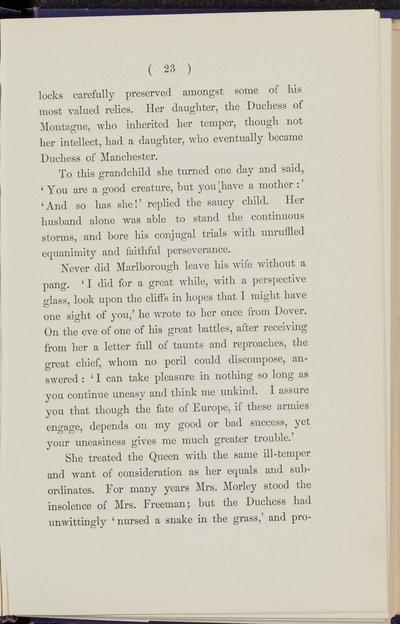
Transcript
( 23) locks carefully preserved amongst some of his most valued relics. Her daughter, the Duchess of Montague, who inherited her temper, though not her intellect, had a daughter, who eventually became Duchess of Manchester. To this grandchild she turned one day and said, ‘You are a good creature, but you ‘have a mother :’ ‘And so has she!’ replied the saucy child. Her husband alone was able to stand the continuous storms, and bore his conjugal trials with unruffled equanimity and faithful perseverance. Never did Marlborough leave his wife without a pang. ‘I did for a great while, with a perspective glass, look upon the cliffs m hopes that I might have one sight of you,’ he wrote to her once from Dover. On the eve of one of his great battles, after receiving from her a letter full of taunts and reproaches, the great chief, whom no peril could discompose, an- swered: ‘I can take pleasure in nothing so long as you continue uneasy and think me unkind. I assure you that though the fate of Europe, if these armies engage, depends on my good or bad success, yet your uneasiness gives me much greater trouble.’ She treated the Queen with the same ill-temper and want of consideration as her equals and sub- ordinates. For many years Mrs. Morley stood the snsolence of Mrs. Freeman; but the Duchess had unwittingly ‘nursed a snake in the grass,’ and pro-