
Lorem ipsum dolor sit amet, consectetur adipiscing elit. Etiam enim nulla, egestas eu hendrerit vel, congue interdum dui. Integer sed leo posuere, consectetur sem id, placerat diam. Suspendisse potenti. Mauris tincidunt libero risus, id aliquam leo eleifend ut. Donec quis luctus urna, quis vulputate nunc. In vel augue lectus. Maecenas faucibus velit libero, ut auctor lacus gravida nec. Sed tempor urna metus, sit amet interdum libero interdum eu. Interdum et malesuada fames ac ante ipsum primis in faucibus. Nullam quis velit sagittis, eleifend dolor sed, luctus enim. Sed mi nisl, cursus eu gravida sit amet, maximus euismod nulla. Duis quam libero, tristique id venenatis eu, vulputate at arcu. Integer pellentesque elementum felis, mattis tristique lacus ullamcorper at.
Search Results
No results found
About 227
- Title: 227
- Author(s): Baron Ferdinand De RothChild
- Date of creation: 1890
- Extent: 2pp
- Material: Paper
- Physical Location: Waddesdon Manor
Annotations
Transcript
‘a
Cab)
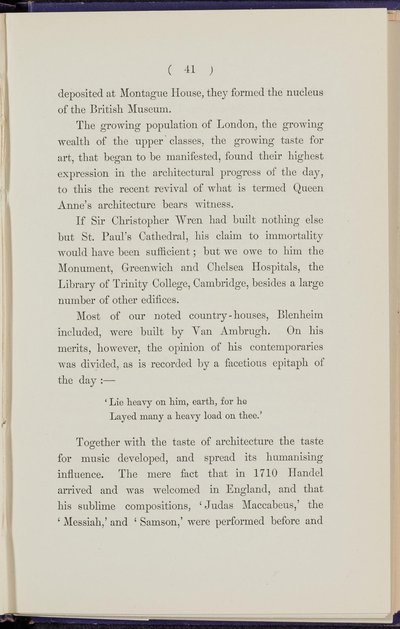
deposited at Montague House, they formed the nucleus
of the British Museum.
The growing population of London, the growing
wealth of the upper classes, the growing taste for
art, that began to be manifested, found their highest
expression in the architectural progress of the day,
to this the recent revival of what is termed Queen
Anne’s architecture bears witness.
If Sir Christopher Wren had built nothing else
but St. Paul’s Cathedral, his claim to immortality
would have been sufficient; but we owe to him the
Monument, Greenwich and Chelsea Hospitals, the
Library of Trinity College, Cambridge, besides a large
number of other edifices.
Most of our noted country-houses, Blenheim
included, were built by Van Ambrugh. On his
merits, however, the opinion of his contemporaries
was divided, as is recorded by a facetious epitaph of
the day :—
‘Lie heavy on him, earth, for he
Layed many a heavy load on thee.’
Together with the taste of architecture the taste
for music developed, and spread its humanising
influence. The mere fact that in 1710 Handel
arrived and was welcomed in England, and that
his sublime compositions, ‘Judas Maccabeus,’ the
‘ Messiah,’ and ‘Samson,’ were performed before and