
Search Results
No results found
About Personal Characteristics from French History (Accession: 226)
- Title: Personal Characteristics from French History (Accession: 226)
- Author(s): Baron Ferdinand de Rothschild
- Date of creation: 1896
- Extent:
- Material: Cloth, leather, paper
- Physical Location: Waddesdon Manor Archive
Annotations
Transcript
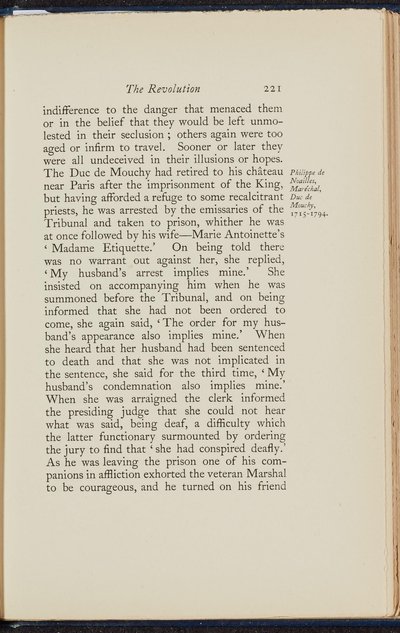
The Revolution 221
indifference to the danger that menaced them
or in the belief that they would be left unmo-
lested in their seclusion ; others again were too
aged or infirm to travel. Sooner or later they
were all undeceived in their illusions or hopes.
The Duc de Mouchy had retired to his chateau
near Paris after the imprisonment of the King,
but having afforded a refuge to some recalcitrant
priests, he was arrested by the emissaries of the
Tribunal and taken to prison, whither he was
at once followed by his wife—Marie Antoinette’s
«Madame Etiquette.’ On being told there
was no warrant out against her, she replied,
‘My husband’s arrest implies mine.’ She
insisted on accompanying him when he was
summoned before the Tribunal, and on being
informed that she had not been ordered to
come, she again said, ‘The order for my hus-
band’s appearance also implies mine.” When
she heard that her husband had been sentenced
to death and that she was not implicated in
the sentence, she said for the third time, ‘My
husband’s condemnation also implies mine.’
When she was arraigned the clerk informed
the presiding judge that she could not hear
what was said, being deaf, a difficulty which
the latter functionary surmounted by ordering
the jury to find that ‘she had conspired deafly.’
As he was leaving the prison one of his com-
panions in affliction exhorted the veteran Marshal
to be courageous, and he turned on his friend
Philippe de
Noailles,
Marێchal,
Duc de
Mouchy,
1715-1794.