
Search Results
No results found
About Personal Characteristics from French History (Accession: 226)
- Title: Personal Characteristics from French History (Accession: 226)
- Author(s): Baron Ferdinand de Rothschild
- Date of creation: 1896
- Extent:
- Material: Cloth, leather, paper
- Physical Location: Waddesdon Manor Archive
Annotations
Transcript
5
The Sixteenth Century 25
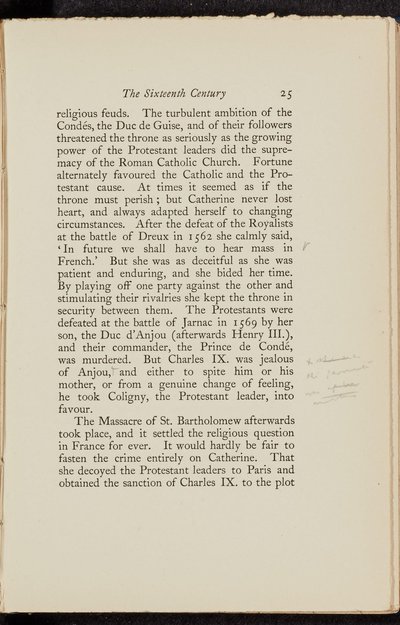
religious feuds. The turbulent ambition of the
Condés, the Duc de Guise, and of their followers
threatened the throne as seriously as the growing
power of the Protestant leaders did the supre-
macy of the Roman Catholic Church. Fortune
alternately favoured the Catholic and the Pro-
testant cause. At times it seemed as if the
throne must perish; but Catherine never lost
heart, and always adapted herself to changing
circumstances. After the defeat of the Royalists
at the battle of Dreux in 1562 she calmly said,
‘In future we shall have to hear mass in
French.’ But she was as deceitful as she was
patient and enduring, and she bided her time.
By playing off one party against the other and
stimulating their rivalries she kept the throne in
security between them. The Protestants were
defeated at the battle of Jarnac in 1569 by her
son, the Duc d’Anjou (afterwards Henry III.),
and their commander, the Prince de Condé,
was murdered. But Charles IX. was jealous
of Anjou, and either to spite him or his
mother, or from a genuine change of feeling,
he took Coligny, the Protestant leader, into
favour.
The Massacre of St. Bartholomew afterwards
took place, and it settled the religious question
in France for ever. It would hardly be fair to
fasten the crime entirely on Catherine. That
she decoyed the Protestant leaders to Paris and
obtained the sanction of Charles IX. to the plot