
Search Results
No results found
About THE NINETEENTH CENTURY (Accession: 224)
- Title: THE NINETEENTH CENTURY (Accession: 224)
- Author(s): Baron Ferdinand de Rothschild
- Date of creation: 1888-1893
- Extent:
- Material: Leather, paper
- Physical Location: Waddesdon Manor Archive
Annotations
Transcript
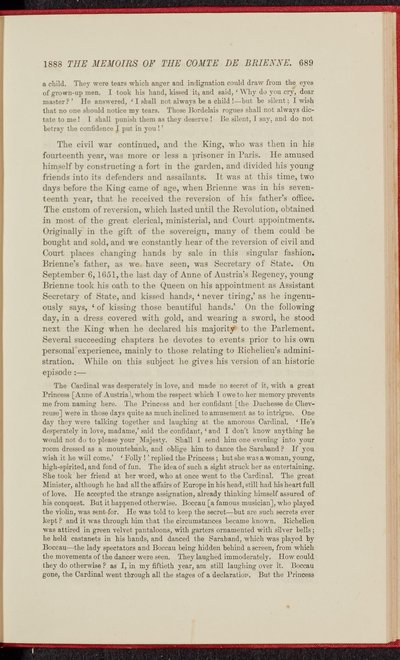
1888 THE MEMOIRS OF THE COMTE DE BRIENNE. 689
achild. They were tears which anger and indignation could draw from the eyes
of grown-up men. I took his hand, kissed it; and said, ‘ Why do you cry, dear
master?’ He answered, ‘I shall not always be a child !—but be silent; I wish
that no one should notice my tears. Those Bordelais rogues shall not always dic-
tate tome! I shall punish them as they deserve! Be silent, I say, and do not
betray the confidence I put in you!’
The civil war continued, and the King, who was then in his
fourteenth year, was more or less a prisoner in Paris. He amused
himself by constructing a fort in the garden, and divided his young
friends into its defenders and assailants. It was at this time, two
days before the King came of age, when Brienne was in his seven-
teenth year, that he received the reversion of his father’s office.
The custom of reversion, which lasted until the Revolution, obtained
in most of the great clerical, ministerial, and Court appointments.
Originally in the gift of the sovereign, many of them could be
bought and sold, and we constantly hear of the reversion of civil and
Court places changing hands by sale in this singular fashion.
Brienne’s father, as we. have seen, was Secretary of State. On
September 6, 1651, the last day of Anne of Austria’s Regency, young
Brienne took his oath to the Queen on his appointment as Assistant
Secretary of State, and kissed hands, ‘ never tiring,’ as he ingenu-
ously says, ‘of kissing those beautiful hands.’ On the following
day, in a dress covered with gold, and wearing a sword, he stood
next the King when he declared his majority’ to the Parlement.
Several succeeding chapters he devotes to events prior to his own
personal experience, mainly to those relating to Richelieu’s admini-
stration. While on this subject he gives his version of an historic
episode :
The Cardinal was desperately in love, and made no secret of it, with a great
Princess [Anne of Austria], whom the respect which I owe to her memory prevents
me from naming here. The Princess and her confidant [the Duchesse de Chev-
reuse] were in those days quite as much inclined to amusement as to intrigue. One
day they were talking together and laughing at the amorous Cardinal. ‘ He’s
desperately in love, madame,’ said the confidant, ‘and I don’t know anything he
would not do to please your Majesty. Shall I send him one evening into your
room dressed as a mountebank, and oblige him to dance the Saraband? If you
wish it he will come.’ ‘ Folly!’ replied the Princess; but she was a woman, young,
high-spirited, and fond of fun. The idea of such a sight struck her as entertaining.
She took her friend at her word, who at once went to the Cardinal. The great
Minister, although he had all the affairs of Europe in his head, still had his heart full
of love. He accepted the strange assignation, already thinking himself assured of
his conquest. But it happened otherwise. Boccau [a famous musician], who played
the violin, was sent-for. He was told to keep the secret—but are such secrets ever
kept? and it was through him that the circumstances became known. Richelieu
was attired in green velvet pantaloons, with garters ornamented with silver bells;
he held castanets in his hands, and danced the Saraband, which was played by
Boccau—the lady spectators and Boccau being hidden behind ascreen, from which
the movements of the dancer were seen. They laughed immoderately. How could
they do otherwise ? as I, in my fiftieth year, am still laughing over it. Boccau
gone, the Cardinal went through all the stages of a declaration, But the Princess