
Search Results
No results found
About THE NINETEENTH CENTURY (Accession: 224)
- Title: THE NINETEENTH CENTURY (Accession: 224)
- Author(s): Baron Ferdinand de Rothschild
- Date of creation: 1888-1893
- Extent:
- Material: Leather, paper
- Physical Location: Waddesdon Manor Archive
Annotations
Transcript
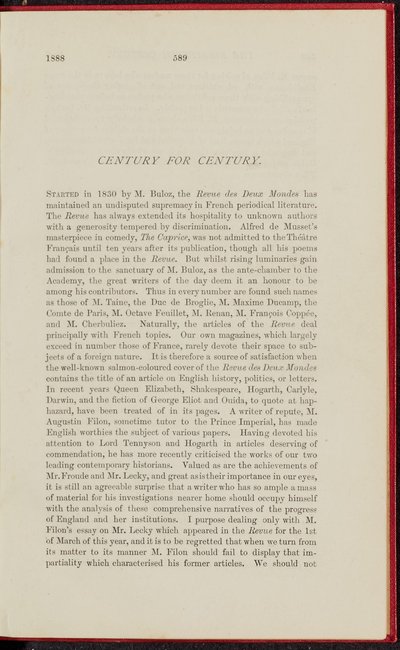
CENTURY FOR CENTURY. Started in 1830 by M. Buloz, the Revwe des Deux Mondes has maintained an undisputed supremacy in French periodical literature. The Revue has always extended its hospitality to unknown authors with a generosity tempered by discrimination. Alfred de Musset’s masterpiece in comedy, The Caprice, was not admitted to the Théatre Francais until ten years after its publication, though all his poems had found a place in the Revue. But whilst rising luminaries gain admission to the sanctuary of M. Buloz, as the ante-chamber to the Academy, the great writers of the day deem it an honour to be among his contributors. Thus in every number are found such names as those of M. Taine, the Duc de Broglie, M. Maxime Ducamp, the Comte de Paris, M. Octave Feuillet, M. Renan, M. Frangois Coppée, and M. Cherbuliez. Naturally, the articles of the Revue deal principally with French topics. Our own magazines, which largely exceed in number those of France, rarely devote their space to sub- jects of a foreign nature. Itis therefore a source of satisfaction when the well-known salmon-coloured cover of the Revwe des Dewx Mondes contains the title of an article on English history, politics, or letters. In recent years Queen Elizabeth, Shakespeare, Hogarth, Carlyle, Darwin, and the fiction of George Eliot and Ouida, to quote at hap- hazard, have been treated of in its pages. A writer of repute, M. Augustin Filon, sometime tutor to the Prince Imperial, has made English worthies the subject of various papers. Having devoted his attention to Lord Tennyson and Hogarth in articles deserving of commendation, he has more recently criticised the works of our two leading contemporary historians. Valued as are the achievements of Mr. Froude and Mr. Lecky, and great asistheir importance in our eyes, it is still an agreeable surprise that a writer who has so ample a mass of material for his investigations nearer home should occupy himself with the analysis of these comprehensive narratives of the progress of England and her institutions. I purpose dealing only with M. Filon’s essay on Mr. Lecky which appeared in the Revwe for the lst of March of this year, and it is to be regretted that when we turn from its matter to its manner M. Filon should fail to display that im- partiality which characterised his former articles. We should not