
Search Results
No results found
About THE NINETEENTH CENTURY (Accession: 224)
- Title: THE NINETEENTH CENTURY (Accession: 224)
- Author(s): Baron Ferdinand de Rothschild
- Date of creation: 1888-1893
- Extent:
- Material: Leather, paper
- Physical Location: Waddesdon Manor Archive
Annotations
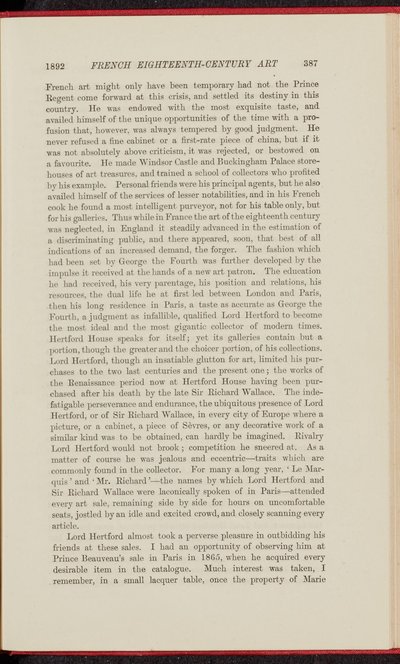
Transcript
1892 FRENCH EIGHTEENTH-CENTURY ART 387
French art might only have been temporary had not the Prince
Regent come forward at this crisis, and settled its destiny in this
country. He was endowed with the most exquisite taste, and
availed himself of the unique opportunities of the time with a pro-
fusion that, however, was always tempered by good judgment. He
never refused a fine cabinet or a first-rate piece of china, but if it
was not absolutely above criticism, it was rejected, or bestowed on
a favourite. He made Windsor Castle and Buckingham Palace store-
houses of art treasures, and trained a school of collectors who profited
by hisexample. Personal friends were his principal agents, but he also
availed himself of the services of lesser notabilities, and in his French
cook he found a most intelligent purveyor, not for his table only, but
for his galleries. Thus while in France the art of the eighteenth century
was neglected, in England it steadily advanced in the estimation of
a discriminating public, and there appeared, soon, that best of all
indications of an increased demand, the forger. The fashion which
had been set by George the Fourth was further developed by the
impulse it received at the hands of a new art patron. The education
he had received, his very parentage, his position and relations, his
resources, the dual life he at first led between London and Paris,
then his long residence in Paris, a taste as accurate as George the
Fourth, a judgment as infallible, qualified Lord Hertford to become
the most ideal and the most gigantic collector of modern times.
Hertford House speaks for itself; yet its galleries contain but a
portion, though the greater and the choicer portion, of his collections.
Lord Hertford, though an insatiable glutton for art, limited his pur-
chases to the two last centuries and the present one; the works of
the Renaissance period now at Hertford House having been pur-
chased after his death by the late Sir Richard Wallace. The inde-
fatigable perseverance and endurance, the ubiquitous presence of Lord
Hertford, or of Sir Richard Wallace, in every city of Europe where a
picture, or a cabinet, a piece of Sévres, or any decorative work of a
similar kind was to be obtained, can hardly be imagined. Rivalry
Lord Hertford would not brook; competition he sneered at. Asa
matter of course he was jealous and eccentric—traits which are
commonly found in the collector. For many along year, ‘ Le Mar-
quis’ and ‘Mr. Richard’—the names by which Lord Hertford and
Sir Richard Wallace were laconically spoken of in Paris—attended
every art sale, remaining side by side for hours on uncomfortable
seats, jostled by an idle and excited crowd, and closely scanning every
article.
Lord Hertford almost took a perverse pleasure in outbidding his
friends at these sales. I had an opportunity of observing him at
Prince Beauveau’s sale in Paris in 1865, when he acquired every
desirable item in the catalogue. Much interest was taken, I
remember, in a small lacquer table, once the property of Marie