
Search Results
No results found
About THE NINETEENTH CENTURY (Accession: 224)
- Title: THE NINETEENTH CENTURY (Accession: 224)
- Author(s): Baron Ferdinand de Rothschild
- Date of creation: 1888-1893
- Extent:
- Material: Leather, paper
- Physical Location: Waddesdon Manor Archive
Annotations
Transcript
1893 CAUSES OF THE FRENCH REVOLUTION 377
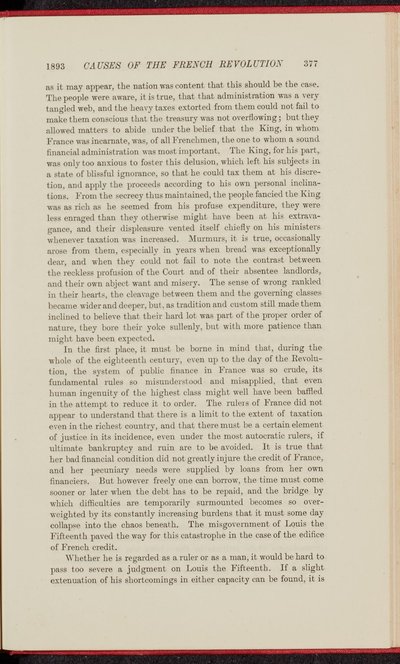
as it may appear, the nation was content that this should be the case.
The people were aware, it is true, that that administration was a very
tangled web, and the heavy taxes extorted from them could not fail to
make them conscious that the treasury was not overflowing; but they
allowed matters to abide under the belief that the King, in whom '
France was incarnate, was, of all Frenchmen, the one to whom a sound
financial administration was most important. The King, for his part,
was only too anxious to foster this delusion, which left his subjects in
a state of blissful ignorance, so that he could tax them at his discre-
tion, and apply the proceeds according to his own personal inclina-
tions. From the secrecy thus maintained, the people fancied the King
was as rich as he seemed from his profuse expenditure, they were
less enraged than they otherwise might have been at his extrava-
gance, and their displeasure vented itself chiefly on his ministers
whenever taxation was increased. Murmurs, it is true, occasionally
arose from them, especially in years when bread was exceptionally
dear, and when they could not fail to note the contrast between
the reckless profusion of the Court and of their absentee landlords,
and their own abject want and misery. The sense of wrong rankled
in their hearts, the cleavage between them and the governing classes
became wider and deeper, but, as tradition and custom still made them
inclined to believe that their hard lot was part of the proper order of
nature, they bore their yoke sullenly, but with more patience than
might have been expected.
In the first place, it must be borne in mind that, during the
whole of the eighteenth century, even up to the day of the Revolu-
tion, the system of public finance in France was so crude, its
fundamental rules so misunderstood and misapplied, that even
human ingenuity of the highest class might well have been bafiled
in the attempt to reduce it to order. The rulers of France did not
appear to understand that there is a limit to the extent of taxation
even in the richest country, and that there must be a certain element
of justice in its incidence, even under the most autocratic rulers, if
ultimate bankruptcy and ruin are to be avoided. It is true that
her bad financial condition did not greatly injure the credit of France,
and her pecuniary needs were supplied by loans from her own
financiers. But however freely one can borrow, the time must come
sooner or later when the debt has to be repaid, and the bridge by
which difficulties are temporarily surmounted becomes so over-
weighted by its constantly increasing burdens that it must some day
collapse into the chaos beneath. The misgovernment of Louis the
Fifteenth paved the way for this catastrophe in the case of the edifice
of French credit.
Whether he is regarded as a ruler or as a man, it would be hard to.
pass too severe a judgment on Louis the Fifteenth. If a slight
extenuation of his shortcomings in either capacity can be found, it is