
Search Results
No results found
About THE NINETEENTH CENTURY (Accession: 224)
- Title: THE NINETEENTH CENTURY (Accession: 224)
- Author(s): Baron Ferdinand de Rothschild
- Date of creation: 1888-1893
- Extent:
- Material: Leather, paper
- Physical Location: Waddesdon Manor Archive
Annotations
Transcript
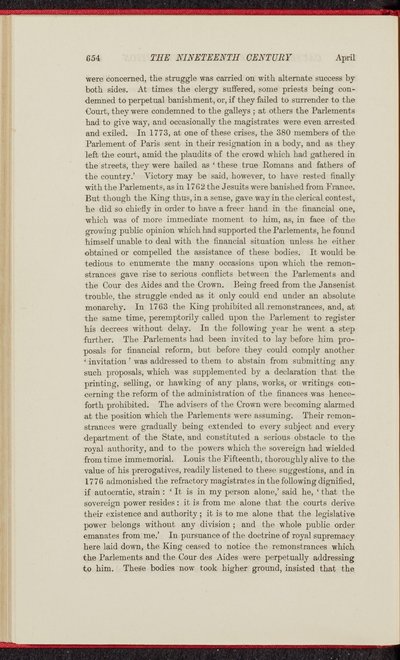
" 654 THE NINETEENTH CENTURY April
i were concerned, the struggle was carried on with alternate success by
i both sides. At times the clergy suffered, some priests being con-
demned to perpetual banishment, or, if they failed to surrender to the
Court, they were condemned to the galleys ; at others the Parlements
| had to give way, and occasionally the magistrates were even arrested
; and exiled. In 1773, at one of these crises, the 380 members of the
Parlement of Paris sent in their resignation in a body, and as they
left the court, amid the plaudits of the crowd which had gathered in
the streets, they were hailed as ‘these true Romans and fathers of
the country.’ Victory may be said, however, to have rested finally
with the Parlements, as in 1762 the Jesuits were banished from France.
But though the King thus, in a sense, gave way in the clerical contest,
he did so chiefly in order to have a freer hand in the financial one,
which was of more immediate moment to him, as, in face of the
growing public opinion which had supported the Parlements, he found
himself unable to deal with the financial situation unless he either
| obtained or compelled the assistance of these bodies. It would be
| tedious to enumerate the many occasions upon which the remon-
strances gave rise to serious conflicts between the Parlements and
the Cour des Aides and the Crown. Being freed from the Jansenist
i) trouble, the struggle ended as it only could end under an absolute
monarchy. In 1763 the King prohibited all.remonstrances, and, at
the same time, peremptorily called upon the Parlement to register
his decrees without delay. In the following year he went a step
further. The Parlements had been invited to lay before him pro-
posals for financial reform, but before they could comply another
‘ invitation ’ was addressed to them to abstain from submitting any
such proposals, which was supplemented by a declaration that the
printing, selling, or hawking of any plans, works, or writings con-
; cerning the reform of the administration of the finances was hence-
forth prohibited. The advisers of the Crown were becoming alarmed
at the position which the Parlements were assuming. Their remon-
strances were gradually being extended to every subject and every
department of the State, and constituted a serious obstacle to the
royal authority, and to the powers which the sovereign had wielded
; from time immemorial. Louis the Fifteenth, thoroughly alive to the
value of his prerogatives, readily listened to these suggestions, and in
1776 admonished the refractory magistrates in the following dignified,
if autocratic, strain: ‘It is in my person alone,’ said he, ‘ that the
sovereign power resides: it is from me alone that the courts derive
their existence and authority ; it is to me alone that the legislative
power belongs without any division; and the whole public order
emanates from me.’ In pursuance of the doctrine of royal supremacy
here laid down, the King ceased to notice the remonstrances which
the Parlements and the Cour des Aides were perpetually addressing
to him. These bodies now took higher ground, insisted that the
= a ie alge gage ae
a oe
wr
etemion: