
Lorem ipsum dolor sit amet, consectetur adipiscing elit. Etiam enim nulla, egestas eu hendrerit vel, congue interdum dui. Integer sed leo posuere, consectetur sem id, placerat diam. Suspendisse potenti. Mauris tincidunt libero risus, id aliquam leo eleifend ut. Donec quis luctus urna, quis vulputate nunc. In vel augue lectus. Maecenas faucibus velit libero, ut auctor lacus gravida nec. Sed tempor urna metus, sit amet interdum libero interdum eu. Interdum et malesuada fames ac ante ipsum primis in faucibus. Nullam quis velit sagittis, eleifend dolor sed, luctus enim. Sed mi nisl, cursus eu gravida sit amet, maximus euismod nulla. Duis quam libero, tristique id venenatis eu, vulputate at arcu. Integer pellentesque elementum felis, mattis tristique lacus ullamcorper at.
Search Results
No results found
About 227
- Title: 227
- Author(s): Baron Ferdinand De RothChild
- Date of creation: 1890
- Extent: 2pp
- Material: Paper
- Physical Location: Waddesdon Manor
Annotations
Transcript
et
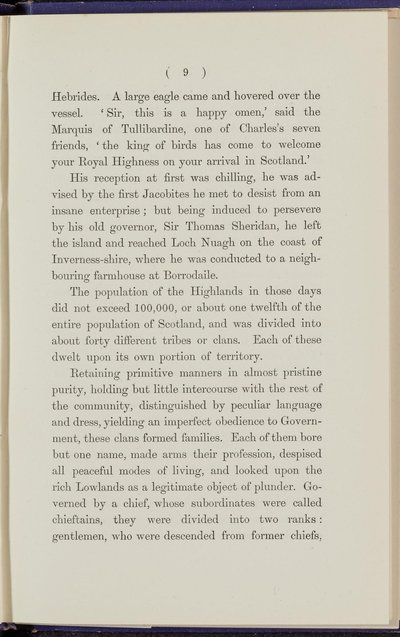
Hebrides. A large eagle came and hovered over the
vessel. ‘Sir, this is a happy omen,’ said the
Marquis of Tullibardine, one of Charles’s seven
friends, ‘the king of birds has come to welcome
your Royal Highness on your arrival in Scotland.’
His reception at first was chilling, he was ad-
vised by the first Jacobites he met to desist from an
insane enterprise ; but being induced to persevere
by his old governor, Sir Thomas Sheridan, he left
the island and reached Loch Nuagh on the coast of
Inverness-shire, where he was conducted to a neigh-
bouring farmhouse at Borrodaile.
The population of the Highlands in those days
did not exceed 100,000, or about one twelfth of the
entire population of Scotland, and was divided into
about forty different tribes or clans. Each of these
dwelt upon its own portion of territory.
Retaining primitive manners in almost pristine
purity, holding but little intercourse with the rest of
the community, distinguished by peculiar language
and dress, yielding an imperfect obedience to Govern-
ment, these clans formed families. Each of them bore
but one name, made arms their profession, despised
all peaceful modes of living, and looked upon the
rich Lowlands as a legitimate object of plunder. Go-
verned by a chief, whose subordinates were called
chieftains, they were divided into two ranks:
gentlemen, who were descended from former chiefs,