
Search Results
No results found
About THE NINETEENTH CENTURY (Accession: 224)
- Title: THE NINETEENTH CENTURY (Accession: 224)
- Author(s): Baron Ferdinand de Rothschild
- Date of creation: 1888-1893
- Extent:
- Material: Leather, paper
- Physical Location: Waddesdon Manor Archive
Annotations
Transcript
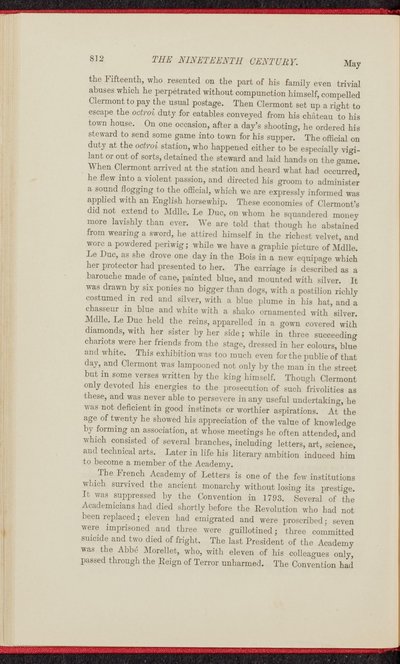
812 THE NINETEENTH CENTURY. May
the Fifteenth, who resented on the part of his family even trivial
abuses which he perpétrated without compunction himself, compelled
Clermont to pay the usual postage. Then Clermont set up aright to
escape the octroi duty for eatables conveyed from his chateau to his
town house. On one occasion, after a day’s shooting, he ordered his
steward to send some game into town for his supper. The official on
duty at the octroi station, who happened either to be especially vigi-
lant or out of sorts, detained the steward and laid hands on the game.
When Clermont arrived at the station and heard what had occurred,
he flew into a violent passion, and directed his groom to administer
a sound flogging to the official, which we are expressly informed was
applied with an English horsewhip. These economies of Clermont’s
did not extend to Mdlle. Le Duc, on whom he squandered money
more lavishly than ever. We are told that though he abstained
from wearing a sword, he attired himself in the richest velvet, and
wore a powdered periwig; while we have a graphic picture of Mdlle.
Le Duc, as she drove one day in the Bois in a new equipage which
her protector had presented to her. The carriage is described as a
barouche made of cane, painted blue, and mounted with silver. It
was drawn by six ponies no bigger than dogs, with a postilion richly
costumed in red and silver, with a blue plume in his hat, and a
chasseur in blue and white with a shako ornamented with silver.
Mdlle. Le Duc held the reins, apparelled in a gown covered with
diamonds, with her sister by her side; while in three succeeding
chariots were her friends from the stage, dressed in her colours, blue
and white. This exhibition was too much even forthe public of that
day, and Clermont was lampooned not only by the man in the street
but in some verses written by the king himself. Though Clermont
only devoted his energies to the prosecution of such frivolities as
these, and was never able to persevere in any useful undertaking, he
was not deficient in good instincts or worthier aspirations. At the
age of twenty he showed his appreciation of the value of knowledge
by forming an association, at whose meetings he often attended, and
which consisted of several branches, including letters, art, science,
and technical arts. Later in life his literary ambition induced him
to become a member of the Academy.
The French Academy of Letters is one of the few institutions
which survived the ancient monarchy without losing its prestige.
It was suppressed by the Convention in 1793. Several of the
Academicians had died shortly before the Revolution who had not
been replaced; eleven had emigrated and were proscribed; seven
were imprisoned and three were guillotined; three committed
i suicide and two died of fright. The last President of the Academy
was the Abbé Morellet, who, with eleven of his colleagues only,
passed through the Reign of Terror unharmed. The Convention had