
Search Results
No results found
About THE NINETEENTH CENTURY (Accession: 224)
- Title: THE NINETEENTH CENTURY (Accession: 224)
- Author(s): Baron Ferdinand de Rothschild
- Date of creation: 1888-1893
- Extent:
- Material: Leather, paper
- Physical Location: Waddesdon Manor Archive
Annotations
Transcript
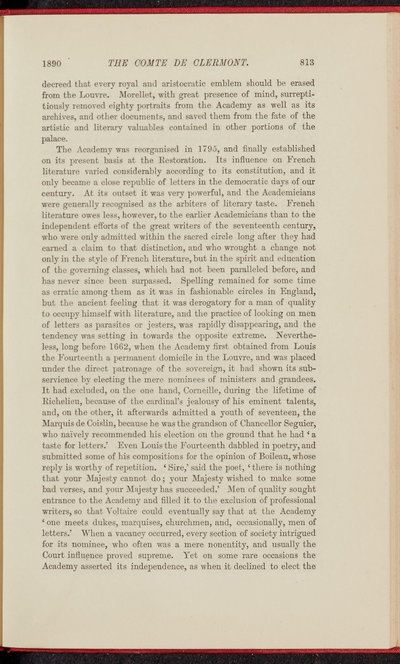
1890 THE COMTE DE CLERMONT. 813
decreed that every royal and aristocratic emblem should be erased
from the Louvre. Morellet, with great presence of mind, surrepti-
tiously removed eighty portraits from the Academy as well as its
archives, and other documents, and saved them from the fate of the
artistic and literary valuables contained in other portions of the
palace.
The Academy was reorganised in 1795, and finally established
on its present basis at the Restoration. Its influence on French
literature varied considerably according to its constitution, and it
only became a close republic of letters in the democratic days of our
century. At its outset it was very powerful, and the Academicians
were generally recognised as the arbiters of literary taste. French
literature owes less, however, to the earlier Academicians than to the
independent efforts of the great writers of the seventeenth century,
who were only admitted within the sacred circle long after they had
earned a claim to that distinction, and who wrought a change not
only in the style of French literature, but in the spirit and education
of the governing classes, which had not been paralleled before, and
has never since been surpassed. Spelling remained for some time
as erratic among them as it was in fashionable circles in England,
but the ancient feeling that it was derogatory for a man of quality
to occupy himself with literature, and the practice of looking on men
of letters as parasites or jesters, was rapidly disappearing, and the
tendency was setting in towards the opposite extreme. Neverthe-
less, long before 1662, when the Academy first obtained from Louis
the Fourteenth a permanent domicile in the Louvre, and was placed
under the direct patronage of the sovereign, it had shown its sub-
servience by electing the mere nominees of ministers and grandees.
It had excluded, on the one hand, Corneille, during the lifetime of
Richelieu, because of the cardinal’s jealousy of his eminent talents,
and, on the other, it afterwards admitted a youth of seventeen, the
Marquis de Coislin, because he was the grandson of Chancellor Seguier,
who naively recommended his election on the ground that he had ‘a
taste for letters.’ Even Louisthe Fourteenth dabbled in poetry, and
submitted some of his compositions for the opinion of Boileau, whose
reply is worthy of repetition. ‘Sire,’ said the poet, ‘there is nothing
that your Majesty cannot do; your Majesty wished to make some
bad verses, and your Majesty has succeeded.’ Men of quality sought
entrance to the Academy and filled it to the exclusion of professional
writers, so that Voltaire could eventually say that at the Academy
‘one meets dukes, marquises, churchmen, and, occasionally, men of
letters.’ When a vacancy occurred, every section of society intrigued
for its nominee, who often was a mere nonentity, and usually the
Court influence proved supreme. Yet on some rare occasions the
Academy asserted its independence, as when it declined to elect the