
Search Results
No results found
About THE NINETEENTH CENTURY (Accession: 224)
- Title: THE NINETEENTH CENTURY (Accession: 224)
- Author(s): Baron Ferdinand de Rothschild
- Date of creation: 1888-1893
- Extent:
- Material: Leather, paper
- Physical Location: Waddesdon Manor Archive
Annotations
Transcript
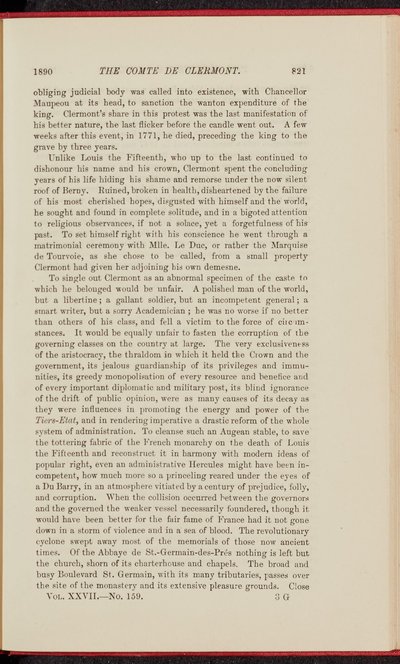
1890 THE COMTE DE CLERMONT. 821
obliging judicial body was called into existence, with Chancellor
Maupeou at its head, to sanction the wanton expenditure of the
king. Clermont’s share in this protest was the last manifestation of
his better nature, the last flicker before the candle went out. A few
weeks after this event, in 1771, he died, preceding the king to the
grave by three years.
Unlike Louis the Fifteenth, who up to the last continued to
dishonour his name and his crown, Clermont spent the concluding
years of his life hiding his shame and remorse under the now silent
roof of Berny. Ruined, broken in health, disheartened by the failure
of his most cherished hopes, disgusted with himself and the world,
he sought and found in complete solitude, and in a bigoted attention
to religious observances, if not a solace, yet a forgetfulness of his
past. To set himself right with his conscience he went through a
matrimonial ceremony with Mlle. Le Duc, or rather the Marquise
de Tourvoie, as she chose to be called, from a small property
Clermont had given her adjoining his own demesne.
To single out Clermont as an abnormal specimen of the caste to
which he belonged would be unfair. A polished man of the world,
but a libertine; a gallant soldier, but an incompetent general; a
smart writer, but a sorry Academician ; he was no worse if no better
than others of his class, and fell a victim to the force of cireim-
stances. It would be equally unfair to fasten the corruption of the
governing classes on the country at large. The very exclusiveness
of the aristocracy, the thraldom in which it held the Crown and the
government, its jealous guardianship of its privileges and immu-
nities, its greedy monopolisation of every resource and benefice and
of every important diplomatic and military post, its blind ignorance
of the drift of public opinion, were as many causes of its decay as
they were influences in promoting the energy and power of the
Tiers-Etat, and in rendering imperative a drastic reform of the whole
system of administration. To cleanse such an Augean stable, to save
the tottering fabric of the l'rench monarchy on the death of Louis
the Fifteenth and reconstruct it in harmony with modern ideas of
popular right, even an administrative Hercules might have been in-
competent, how much more so a princeling reared under the eyes of
a Du Barry, in an atmosphere vitiated by a century of prejudice, folly,
and corruption. When the collision occurred hetween the governors
and the governed the weaker vessel necessarily foundered, though it
would have been better for the fair fame of France had it not gone
down in a storm of violence and in a sea of blood. The revolutionary
cyclone swept away most of the memorials of those now ancient
times. Of the Abbaye de St.-Germain-des-Prés nothing is left but
the church, shorn of its charterhouse and chapels. The broad and
busy Boulevard St. Germain, with its many tributaries, passes over
the site of the monastery and its extensive pleasure grounds. Close
VoL. XXVII.—No. 159. 3G