
Search Results
No results found
About THE NINETEENTH CENTURY (Accession: 224)
- Title: THE NINETEENTH CENTURY (Accession: 224)
- Author(s): Baron Ferdinand de Rothschild
- Date of creation: 1888-1893
- Extent:
- Material: Leather, paper
- Physical Location: Waddesdon Manor Archive
Annotations
Transcript
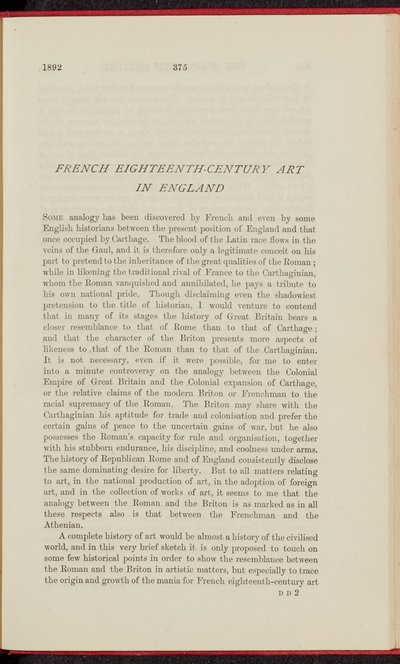
FRENCH FIGHTEENTH-CENTOURY ART
IN ENGLAND
Some analogy has been discovered by French and even by some
English historians between the present position of England and that
once occupied by Carthage. The blood of the Latin race flows in the
veins of the Gaul, and it is therefore only a legitimate conceit on his
part to pretend to the inheritance of the great qualities of the Roman ;
while in likening the traditional rival of France to the Carthaginian,
whom the Roman vanquished and annihilated, he pays a tribute to
his own national pride. Though disclaiming even the shadowiest
pretension to the title of historian, I would venture to contend
that in many of its stages the history of Great Britain bears a
closer resemblance to that of Rome than to that of Carthage ;
and that the character of the Briton presents more aspects of
likeness to that of the Roman than to that of the Carthaginian.
It is not necessary, even if it were possible, for me to enter
into a minute controversy on the analogy between the Colonial
Empire of Great Britain and the Colonial expansion of Carthage,
or the relative claims of the modern Briton or Frenchman to the
racial supremacy of the Roman. The Briton may share with the
Carthaginian his aptitude for trade and colonisation and prefer the
certain gains of peace to the uncertain gains of war, but he also
possesses the Roman’s capacity for rule and organisation, together
with his stubborn endurance, his discipline, and coolness under arms.
The history of Republican Rome and of England consistently disclose
the same dominating desire for liberty. But to all matters relating
to art, in the national production of art, in the adoption of foreign
art, and in the collection of works of art, it seems to me that the
analogy between the Roman and the Briton is as marked as in all
these respects also is that between the Frenchman and the
Athenian.
A complete history of art would be almost a history of the civilised
world, and in this very brief sketch it is only proposed to touch on
some few historical points in order to show the resemblance between
the Roman and the Briton in artistic matters, but especially to trace
the origin and growth of the mania for French eighteenth-century art
DD2