
Search Results
No results found
About THE NINETEENTH CENTURY (Accession: 224)
- Title: THE NINETEENTH CENTURY (Accession: 224)
- Author(s): Baron Ferdinand de Rothschild
- Date of creation: 1888-1893
- Extent:
- Material: Leather, paper
- Physical Location: Waddesdon Manor Archive
Annotations
Transcript
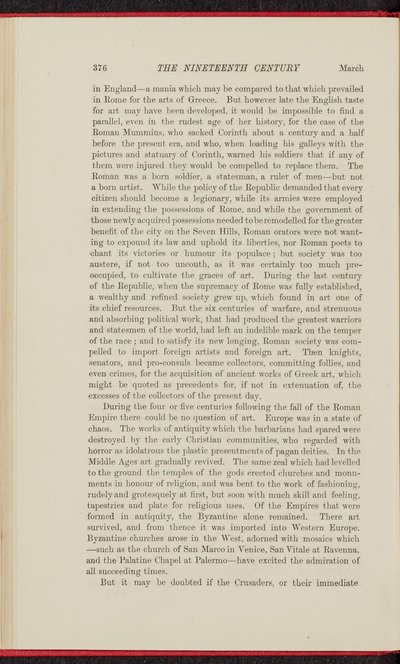
376 THE NINETEENTH CENTURY March
in England—a mania which may be compared to that which prevailed
in Rome for the arts of Greece. But however late the English taste
for art may have been developed, it would be impossible to find a
parallel, even in the rudest age of her history, for the case of the
Roman Mummius, who sacked Corinth about a century and a half
before the present era, and who, when loading his galleys with the
pictures and statuary of Corinth, warned his soldiers that if any of
them were injured they would be compelled to replace them. The
Roman was a born soldier, a statesman, a ruler of men—but not
a born artist. While the policy of the Republic demanded that every
citizen should become a legionary, while its armies were employed
in extending the possessions of Rome, and while the government of
those newly acquired possessions needed to be remodelled for the greater
benefit of the city on the Seven Hills, Roman orators were not want-
ing to expound its law and uphold its liberties, nor Roman poets to
chant its victories or humour its populace; but society was too
austere, if not too uncouth, as it was certainly too much pre-
occupied, to cultivate the graces of art. During the last century
of the Republic, when the supremacy of Rome was fully established,
a wealthy and refined society grew up, which found in art one of
its chief resources. But the six centuries of warfare, and strenuous
and absorbing political work, that had produced the greatest warriors
and statesmen of the world, had left an indelible mark on the temper
of the race ; and to satisfy its new longing, Roman society was com-
pelled to import foreign artists and foreign art. Then knights,
senators, and pro-consuls became collectors, committing follies, and
even crimes, for the acquisition of ancient works of Greek art, which
might be quoted as precedents for, if not in extenuation of, the
excesses of the collectors of the present day.
During the four or five centuries following the fall of the Roman
Empire there could be no question of art. Europe was in a state of
chaos. The works of antiquity which the barbarians had spared were
destroyed by the early Christian communities, who regarded with
horror as idolatrous the plastic presentments of pagan deities. In the
Middle Ages art gradually revived. The same zeal which had levelled
to the ground the temples of the gods erected churches and monu-
ments in honour of religion, and was bent to the work of fashioning,
rudely and grotesquely at first, but soon with much skill and feeling,
tapestries and plate for religious uses. Of the Empires that were
formed in antiquity, the Byzantine alone remained. There art
survived, and from thence it was imported into Western Europe.
Byzantine churches arose in the West, adorned with mosaics which
—such as the church of San Marcoin Venice, San Vitale at Ravenna,
and the Palatine Chapel at Palermo—have excited the admiration of
all succeeding times.
But it may be doubted if the Crusaders, or their immediate