
Search Results
No results found
About THE NINETEENTH CENTURY (Accession: 224)
- Title: THE NINETEENTH CENTURY (Accession: 224)
- Author(s): Baron Ferdinand de Rothschild
- Date of creation: 1888-1893
- Extent:
- Material: Leather, paper
- Physical Location: Waddesdon Manor Archive
Annotations
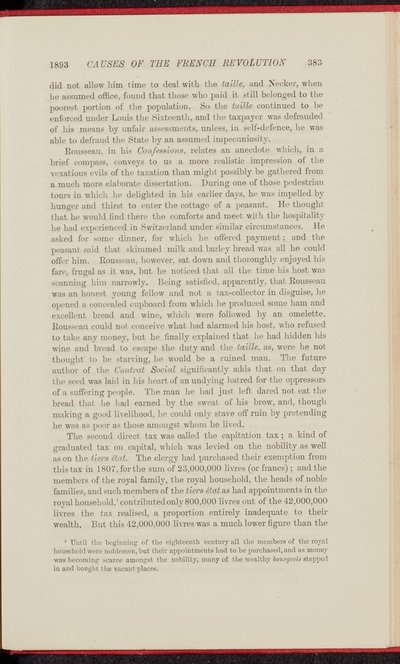
Transcript
1893 CAUSES OF THE FRENCH REVOLUTION 383
did not allow him time to deal with the taille, and Necker, when
he assumed office, found that those who paid it still belonged to the
poorest portion of the population. So the taille continued to be
enforced under Louis the Sixteenth, and the taxpayer was defrauded
of his means by unfair assessments, unless, in self-defence, he was '
able to defraud the State by an assumed impecuniosity.
Rousseau, in his Confessions, relates an anecdote which, in a
brief compass, conveys to. us a more realistic impression of the
vexatious evils of the taxation than might possibly be gathered from
a much more elaborate dissertation. During one of those pedestrian
tours in which he delighted in his earlier days, he was impelled by
hunger and thirst to enter the cottage of a peasant. He thought
that he would find there the comforts and meet with the hospitality
he had experienced in Switzerland under similar circumstances. He
asked for some dinner, for which he offered payment; and the
peasant said that skimmed milk and barley bread was all he could
offer him. Rousseau, however, sat down and thoroughly enjoyed his
fare, frugal as it was, but he noticed that all the time his host was
scanning him narrowly. Being satisfied, apparently, that Rousseau
was an honest young fellow and not a tax-collector in disguise, he
opened a concealed cupboard from which he produced some ham and
excellent bread and wine, which were followed by an omelette.
Rousseau could not conceive what had alarmed his host, who refused
to take any money, but he finally explained that he had hidden his
wine and bread to escape the duty and the taille, as, were he not
thought’ to be starving, he would be a ruined man. The future
author of the Contrat Social significantly adds that on that day
the seed was laid in his heart of an undying hatred for the oppressors
of a suffering people. The man he had just left dared not eat the
bread that he had earned by the sweat of his brow, and, though
making a good livelihood, he could only stave off ruin by pretending
he was as poor as those amongst whom he lived.
The second direct tax was called the capitation tax; a kind of
graduated tax on capital, which was levied on the nobility as well
as on the tiers état. The clergy had purchased their exemption from
this tax in 1807, for the sum of 23,000,000 livres (or francs) ; and the
members of the royal family, the royal household, the heads of noble
families, and such members of the tiers état as had appointments in the
royal household,' contributed only 800,000 livres out of the 42,000,000
livres the tax realised, a proportion entirely inadequate to their
wealth, But this 42,000,000 livres was a much lower figure than the
1 Until the beginning of the eighteenth century all the members of the royal
household were noblemen, but their appointments had to be purchased, and as money
was becoming scarce amongst the nobility, many of the wealthy bowrgeots stepped
in and bought the vacant places.