
Search Results
No results found
About THE NINETEENTH CENTURY (Accession: 224)
- Title: THE NINETEENTH CENTURY (Accession: 224)
- Author(s): Baron Ferdinand de Rothschild
- Date of creation: 1888-1893
- Extent:
- Material: Leather, paper
- Physical Location: Waddesdon Manor Archive
Annotations
Transcript
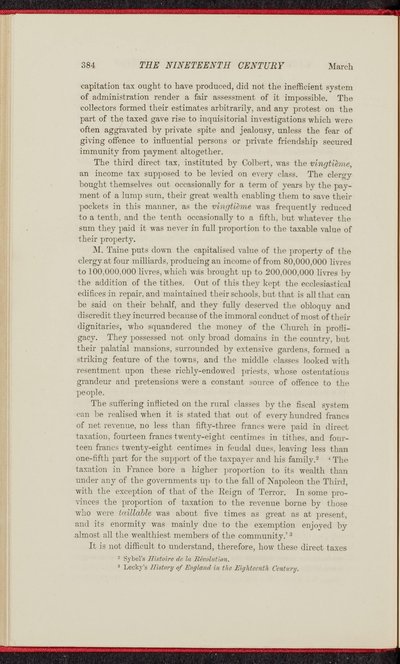
384 THE NINETEENTH CENTURY March
capitation tax ought to have produced, did not the inefficient system
of administration render a fair assessment of it impossible. The
collectors formed their estimates arbitrarily, and any protest on the
part of the taxed gave rise to inquisitorial investigations which were
often aggravated by private spite and jealousy, unless the fear of
giving offence to influential persons or private friendship secured
immunity from payment altogether.
The third direct tax, instituted by Colbert, was the vingtieme,
an income tax supposed to be levied on every class. The clergy
bought themselves out occasionally for a term of years by the pay-
ment of a lump sum, their great wealth enabling them to save their
pockets in this manner, as the wingtiéme was frequently reduced
to a tenth, and the tenth occasionally to a fifth, but whatever the
sum they paid it was never in full proportion to the taxable value of
their property.
M. Taine puts down the capitalised value of the property of the
clergy at four milliards, producing an income of from 80,000,000 livres
to 100,000,000 livres, which was brought up to 200,000,000 livres by
the addition of the tithes. Out of this they kept the ecclesiastical
edifices in repair, and maintained their schools, but that is all that can
be said on their behalf, and they fully deserved the obloquy and
discredit they incurred because of the immoral conduct of most of their
dignitaries, who squandered the money of the Church in profli-
gacy. They possessed not only broad domains in the country, but
their palatial mansions, surrounded by extensive gardens, formed a
striking feature of the towns, and the middle classes looked with
resentment upon these richly-endowed priests, whose ostentatious
grandeur and pretensions were a constant source of offence to the
people.
The suffering inflicted on the rural classes by the fiscal system
can be realised when it is stated that out of every hundred francs
of net revenue, no less than fifty-three francs were paid in direct
taxation, fourteen francs twenty-eight centimes in tithes, and four-
teen francs twenty-eight centimes in feudal dues, leaving less than
one-fifth part for the support of the taxpayer and his family.2 ‘The
taxation in France bore a higher proportion to its wealth than
under any of the governments up to the fall of Napoleon the Third,
with the exception of that of the Reign of Terror. In some pro-
vinces the proportion of taxation to the revenue borne by those
who were taillable was about five times as great as at present,
and its enormity was mainly due to the exemption enjoyed by
almost all the wealthiest members of the community.’ 4
It is not difficult to understand, therefore, how these direct taxes
2 Sybel’s Histoire de la Révolution.
* Lecky’s History of England in the Eighteenth Century.